


Search isn’t dying. It’s evolving.
For more than two decades, organizations have competed for one thing: Google’s first page. Marketing teams invested heavily in search engine optimization, built extensive content libraries, researched keywords and celebrated every climb in rankings. The objective was simple: be found.
That objective hasn’t changed, but the way people discover information has.
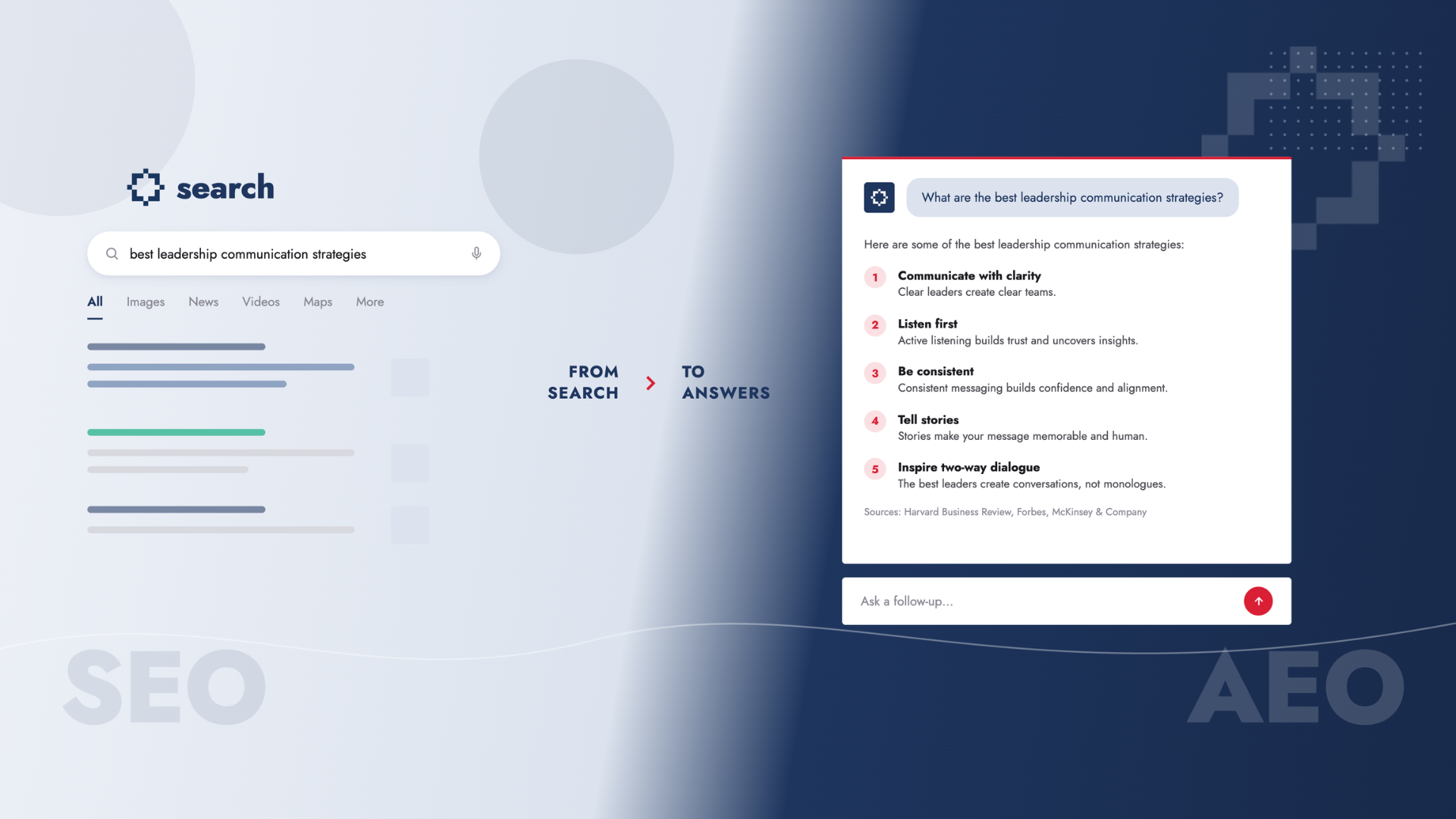
Consumers are increasingly turning to ChatGPT, Gemini, Perplexity, Claude and Google’s AI Overviews to answer questions that once began with a traditional search. Rather than scrolling through pages of links, they’re asking complete questions and receiving curated, conversational answers.
The trend line backs this up: ChatGPT’s referral traffic is now growing roughly 3.8 times faster, month over month, than Google’s, even though Google still commands the overwhelming majority of total search traffic (Ahrefs, 2025).
“behavioral health services Orange County”
“What are the best behavioral health resources in Orange County?”
The response they receive isn’t always a list of websites. More often, it’s an AI-generated recommendation built from information gathered across the internet.
For organizations, this represents one of the most significant changes in digital discoverability since Google transformed how people searched the web.
From SEO to AEO
This shift has given rise to a new discipline: Answer Engine Optimization (AEO). While SEO focuses on helping websites rank in search results, AEO focuses on helping organizations become the answer AI platforms recommend.
It may sound like a subtle distinction, but it fundamentally changes how organizations think about visibility.
Compete for the ranking
– Crawls webpages & matches keywords
– Returns a list of blue links
– Success measured by position
– Reader chooses from results
AEO
Become the answer
+ Synthesizes dozens of trusted sources
+ Returns one curated recommendation
+ Success measured by credibility
+ AI decides who to trust
Rather than simply crawling webpages and matching keywords, AI systems evaluate information from dozens of trusted sources, synthesize what they find and recommend the organizations they believe best answer a user’s question. Businesses are now competing for credibility, authority and trust, not just search rankings.
Where AI gets its answers
One of the biggest misconceptions about AI is that it simply “knows” the answer. In reality, it assembles responses by evaluating signals from across the web.
Earned media coverage
Industry publications
LinkedIn & executive content
Customer reviews
Government resources
Research studies
Professional associations
Podcasts & YouTube transcripts
Wikipedia
Third-party articles & blogs
Together, these sources create your organization’s digital footprint. The stronger, more consistent and more credible that footprint is, the more confidence AI has in recommending your organization.
This channel is scaling fast: Gen AI platforms drove more than 1.1 billion referral visits to websites in a single month in 2025, up 357% year over year (Similarweb, 2025).

Why this matters for communications
This is a communications shift, not a marketing trend. For years, organizations treated public relations, SEO, content marketing, social media and executive thought leadership as separate disciplines. AI is merging them into one.
Every media interview, LinkedIn article, conference presentation, case study, award submission, news story and podcast appearance contributes to the body of knowledge AI uses to understand your organization.
Communications used to shape perception. Now it’s the foundation of discoverability.
PR’s job description just got bigger
One of the most important implications of AEO is the renewed value of earned media. For decades, public relations professionals have worked to build credibility through trusted third-party voices. Today, that same credibility is helping shape AI-generated recommendations.
When respected publications quote your executives, feature your work or recognize your organization, those mentions become authority signals AI can reference when answering questions.
Earned media doesn’t just build reputation anymore. It helps build discoverability.
Your website has a new job
Historically, the primary purpose of a website was to attract visitors. Increasingly, its role is to educate both people and AI.
That means organizations should rethink the content they’re creating. AI favors information that demonstrates expertise: original research, industry insights, case studies, data, FAQs, clear service descriptions and authoritative resources.
Organizations producing unique knowledge have a significant advantage over those publishing generic content that could have been written by anyone, or generated by anything.
Original thinking is becoming a competitive advantage
Artificial intelligence has dramatically lowered the barrier to creating content. It has not lowered the barrier to creating expertise.
AI can summarize, rewrite and organize information, but it cannot replace firsthand experience, original research or informed perspective. That’s why organizations investing in thought leadership are likely to see increasing returns.
In a world where anyone can generate content, original thinking becomes one of the few remaining competitive advantages.
Is your organization AI-ready?
Read each statement below and mentally tally how many are true for your organization.
If someone asked ChatGPT about our organization, it would accurately explain who we are and what we do.
Our website clearly explains our services, expertise and differentiators.
Our executives regularly publish thought leadership or share industry insights.
We consistently earn media coverage or recognition from trusted third-party sources.
We publish original content that demonstrates expertise, not just company news.
Our website includes educational resources such as FAQs, case studies, reports or guides.
Our evergreen content is reviewed and updated regularly.
We monitor how AI platforms and search engines describe our organization.
We have a strong collection of online reviews, testimonials or client success stories.
Our organization is known for a specific area of expertise.
What your score means
0–4: Foundational
There’s meaningful opportunity ahead. Right now AI has little to work with when someone asks about you. A focused authority strategy can move the needle fast.
5–7: Building Momentum
You’ve laid real groundwork, but there are clear gaps between where you are and where AI-first discovery is heading. Targeted moves now will compound quickly.
8–10: AI-Ready
You’re already building the authority AI trusts and are positioned to be recommended. Now it’s about defending and deepening that lead.
What leading organizations are doing differently
The organizations ahead of this shift are expanding their SEO playbook, not retiring it.
01
Invest in executive thought leadership
02
Publish original research
03
Build resource hubs, not keyword blogs
04
Strengthen media relations
05
Earn industry recognition
06
Refresh evergreen content regularly
07
Track the questions customers ask
08
Measure AI referral traffic
They’re also paying closer attention to the questions customers are asking and beginning to measure referral traffic from AI platforms alongside traditional search engines. Most importantly, they’re recognizing that discoverability now runs through communications, not just technical SEO.
The organizations AI recommends tomorrow are investing in their authority today.
Search is becoming conversational.
Marketing is becoming more integrated.
And PR is becoming one of the strongest authority signals available to both people and AI.
Organizations that embrace Answer Engine Optimization today won’t simply improve their visibility. They’ll strengthen their credibility, build greater trust and increase their likelihood of being recommended when customers turn to AI for answers.
As AI becomes the first stop for more questions, credibility may become the most valuable marketing asset an organization can own.
Ready When You Are
Get your personalized AI Discoverability Assessment
A practical, no-fluff breakdown of where you stand today, plus a complimentary 30-minute consultation.

We are champions of all things good.
Sources
Ahrefs. (2025, August 19). ChatGPT vs. Google: Live traffic share comparison [Data analysis]. https://chatgpt-vs-google.com/
Similarweb. (2025, December 2). AI discovery surges: Similarweb’s 2025 generative AI report says [Press release]. https://ir.similarweb.com/news-events/press-releases/detail/138/ai-discovery-surges-similarwebs-2025-generative-ai-report-says